
The Migration of Black Genius
What happens to what we know when we leave the places where our genius has been operating?
By Dr. Asia Lyons | October 2026
For the past six years, I have been examining the varying reasons Black people leave careers in education. The answer to that question started with my own exit story, but it became more robust with each interview I conducted with Black former educators for The Exit Interview: A Podcast for Black Educators. I have heard stories across geographies, generations, beginnings, and endings. Some themes repeat themselves, while others continue to surprise me.
On the podcast, I ask many of the same questions: What was your journey into education? How did you know education was for you? What situations helped you decide it was time to leave? What do you believe schools, districts, and unions can do to retain Black educators? Who is a Black educator you would like to shout out? What are you doing now? And what does it mean for you to be well?
Nearly 100 episodes later, I find myself asking another question, not of my guests, but of myself: What happens to what a person knows after they leave a traditional education space?
Through a framework I call The Migration of Black Genius, I am beginning to answer that question.
What I Mean by Black Genius
Black genius is the brilliance Black people carry. It includes our knowledge, creativity, cultural understanding, relationships, and ways of seeing the world. It is shaped by what we have learned formally and informally, what we have experienced, the communities that have raised us, and the conditions we have learned to navigate.
W.E.B. Du Bois's concept of double consciousness also helps me think about the multiple vantage points from which Black people learn to see ourselves and the world around us. Living within racialized systems can require us to notice patterns, contradictions, dangers, and possibilities that others may not have had to develop the ability to see. Those ways of seeing become part of what we know and how we move through the world.
In education, Black people create more than curriculum. We create strategies, relationships, conversations, and spaces that show us what might be possible for students, educators, families, and communities.
Black genius is also deeply individual. I think of it like a fingerprint. Black educators may share experiences with one another, but no two people arrive in a classroom, principal's office, college campus, or football field carrying exactly the same history. What we have learned and experienced throughout our lives accumulates into something uniquely ours.
Most importantly, genius belongs to the person who carries it.
An institution may pay for professional development, send someone to a conference, provide training, or create opportunities for a person to strengthen particular skills. What the person learns, however, becomes part of what they know. An institution can be a place where genius is expressed, practiced, and expanded, but it is neither its source nor its owner.
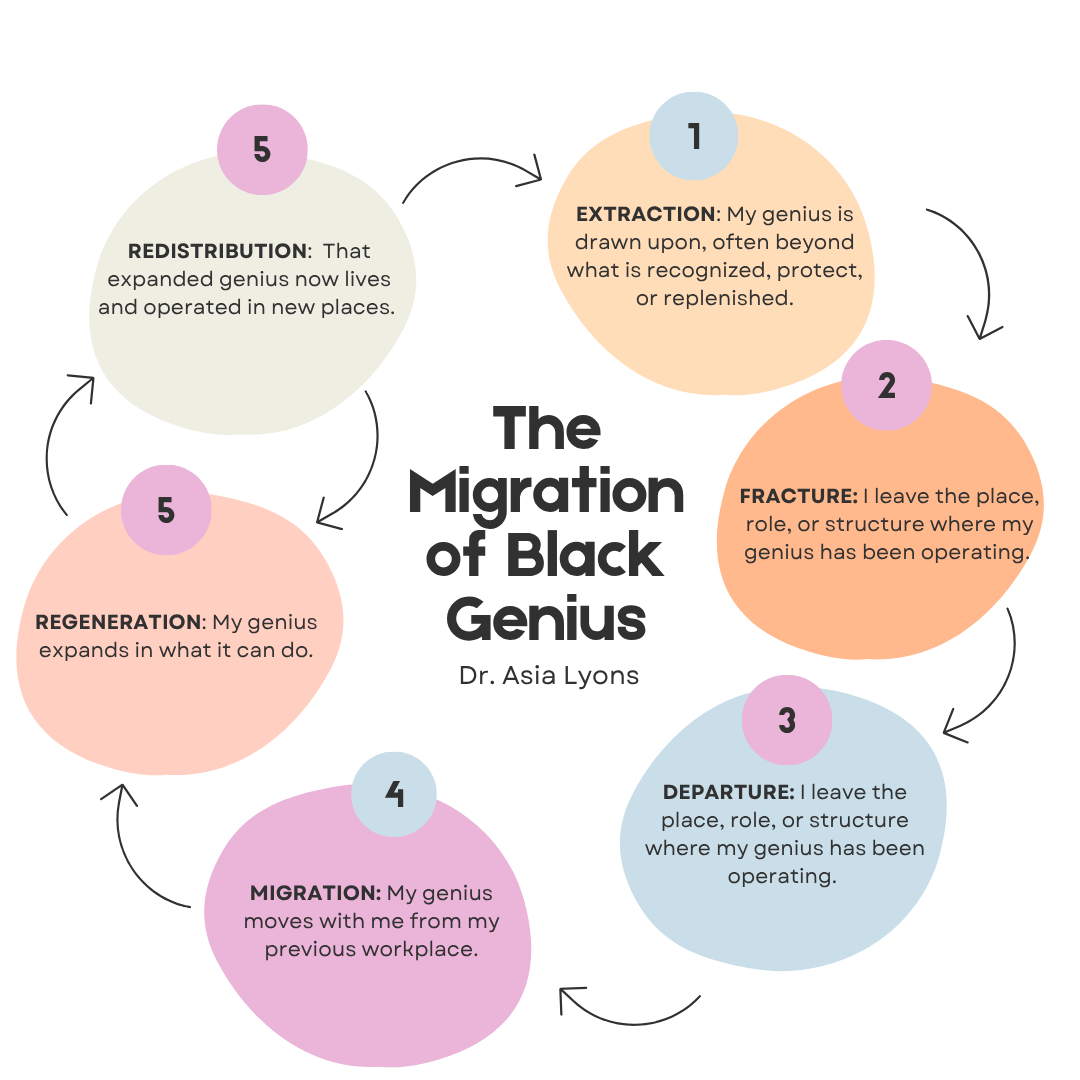
I Began Seeing Migration
During the first season of The Exit Interview, I asked guests, "What are you doing now that you are no longer in a traditional education space?" At the time, I imagined the audience would primarily include Black educators and their families. I wanted listeners to understand that Black educators don’t dissolve into the ether after leaving a classroom, principal's office, college campus, or football field. They find their way.
I also wanted people experiencing racial battle fatigue, compassion fatigue, burnout, or exhaustion to hear that leaving did not necessarily mean the end of meaningful work, purpose, or contribution. Departure could be the beginning of something else, even if the person leaving could not yet see what that something would become.
Over time, I noticed how varied the answers to my question were. I heard Black people alchemizing what they knew into careers sometimes closely connected to education and sometimes far removed from it. I heard about new professions, entrepreneurship, writing, rest, community work, and lives that did not fit neatly into a single category.
After six years of guest storykeeping, one thing became increasingly clear to me: these people were not leaving empty-handed. They carried strategies, relationships, stories, ideas, skills, networks, and memories. They carried a willingness to enact their audacity in places they could not necessarily have imagined at the beginning of their careers.
That is where I began seeing migration.
The Migration of Black Genius Framework
The Migration of Black Genius emerged from my qualitative research, my own observations, and the stories Black former educators have trusted me to hold through The Exit Interview. Although education is the place where I first began recognizing the pattern, I believe the framework speaks more broadly to the movement of Black people and what we know.
At its center is a simple premise: Black genius belongs to the Black person. When we move, what we know moves with us.
A workplace may be one place where our genius operates, but our knowledge is not bound to that workplace. Neither is it bound to one job title, profession, geographic location, or period of our lives. I currently understand the Migration of Black Genius through six interconnected movements: Extraction, Fracture, Departure, Migration, Regeneration, and Redistribution. I use the word movements intentionally because these experiences are not always neat or linear. They can overlap, repeat, and unfold over a person's life.
Extraction
My genius is drawn upon, often beyond what is recognized, protected, or replenished.
Extraction extends beyond the work someone was hired to do. It can draw on a person's energy, health, cultural knowledge, relationships, and capacity to continually navigate conditions that take more than they restore. In my research with Black educators, racial battle fatigue can accumulate within these conditions.
Fracture
My relationship with the place where my genius has been operating becomes unsustainable.
Fracture can happen suddenly, but it can also develop over time. For some Black educators, there is a recognizable last straw. For others, repeated extraction and racialized stress gradually change what they are willing or able to continue enduring. The fracture is in the relationship between the person and the place, not within the person.
Departure: Leaving a Particular Container
I leave the place, role, or structure where my genius has been operating.
Black people leave education for many reasons, and not every departure follows the same path. In my doctoral research and through the podcast, however, I have heard many stories in which departure follows prolonged racial battle fatigue and extraction. For this framework, departure does not mean the person or what they know disappears. The person is leaving a particular container in which their genius has been operating. The genius itself does not remain behind.
Migration: The Person Moves and the Knowledge Moves
I move, and what I know moves with me.
Migration is where the portability of genius becomes visible. Before leaving education, a person may primarily understand their genius through the place where they have been using it. A teacher knows what their brilliance looks like in a classroom. A principal knows how theirs operates within a school community. A coach knows how theirs functions on a field. Those are real expressions of their genius.
Migration makes it possible to see that what the person knows isn’t confined to those settings. Their ability to teach, lead, build relationships, organize, create, advocate, or imagine belongs to them. When the person moves, those ways of knowing move too. This is why I understand migration as more than changing jobs. A person may move into another profession, take a sabbatical, begin a business, retire, return to school, or spend time deciding what they want next. Migration is not simply movement from Employer A to Employer B. It is the movement of the Black person and what they carry across space, place, and time.
Regeneration: Genius Expands
My genius expands in what it can do.
Regeneration does not mean discovering that what came before was false or less valuable than what comes next. The degrees, training, relationships, practice, successes, failures, and years spent developing expertise remain part of the person. What someone knew how to do before departure does not disappear because the setting has changed.
Instead, existing genius encounters new experiences, people, knowledge, and possibilities. Something developed in one setting may combine with something learned in another and take on an expression the person could not have imagined earlier. That iteration of genius was real. Now it can do more. Regeneration is not limited to professional achievement or the production of something new. It can also change how a person rests, relates, imagines, and understands what is possible for their life. Genius expands because the person continues to live, learn, encounter, and imagine.
Redistribution: Where Expanded Genius Lives
If regeneration is about what our genius can become, redistribution is about where that expanded genius can now live.
Our genius does not have to travel neatly from one institution to another. It may live in another profession, in community, in creative work, or across several parts of a person's life at once. The educator who knows how to create community does not lose that ability when they leave a school. Neither does the person who knows how to make difficult ideas understandable, bring people together, or see possibilities that others have overlooked. Those ways of knowing travel with the person. Through regeneration, our genius encounters new experiences and possibilities. Through redistribution, that expanding genius begins operating in new places.
This is why I am becoming less interested in asking what an institution has lost and more interested in asking: Where did the person go, and where is their genius living now?
The Movement Continues
Although I describe regeneration and redistribution separately, I do not believe they always occur in a neat sequence. They can happen simultaneously and continue producing one another.
A new space may allow someone to use something they already know in a way they had never considered. That experience may expand their genius and lead them somewhere else. Once there, what they encounter may expand their genius again. Migration, then, is not simply movement from one workplace to another. It can continue throughout a person's life as what they know encounters new people, experiences, and possibilities. What their genius can do expands, where it can live expands, and the movement continues.
This is part of why I understand Black genius as mobile rather than fixed. It does not have to remain attached to the role, title, profession, or place where it was first recognized.
Migration Through Time: Storykeeping and Cultural Memory
Black genius can migrate not only across space and place, but across time. Not all migration requires physical movement. Black genius can also move through story. When we record and preserve our experiences, knowledge, memories, and ways of understanding the world, they can become part of cultural memory. Community members no longer have to encounter us directly through teaching, mentoring, conversation, or shared physical space to engage with an expression of what we know. This possibility has changed how I understand my own work on The Exit Interview.
For six years, Black former educators have trusted me with stories about their work, families, harm, joy, departure, wellness, and what came next. In the moment of an interview, the exchange happens among the guest, me, and whoever happens to be listening. Once that story is recorded, however, it gains another way to move.
Someone can encounter that story years later, from another city, profession, or generation, under circumstances neither the guest nor I could have imagined when we recorded it. As The Exit Interview becomes part of the Schomburg Center for Research in Black Culture's archival collection, I have started thinking more deeply about what that means. The archive does not own the genius expressed within those stories. The genius remains connected to the people who carried, developed, and shared it. Preservation creates another pathway through which communities can encounter it. In that way, expressions of Black genius can continue migrating across time, entering cultural memory and becoming available to people who were not present when the knowledge was first shared.
What Becomes Possible
The Migration of Black Genius asks us to understand Black genius as something we carry rather than something granted to us by a profession, title, or institution. Where we work may shape how our genius develops and give us opportunities to use it, but it does not determine where it can go or what it can become. What interests me now is how expansive that understanding is. When Black people recognize that what we know is ours to carry, departure does not have to mean starting over. We move forward with what we have learned, created, practiced, endured, and imagined, allowing that knowledge to encounter new places and new possibilities.
The Migration of Black Genius is still an idea I am developing through research, storykeeping, and listening. So far, I know our genius is not static. It moves with us, expands as we do, and finds expression in places we may not have been able to imagine from where we began. Through the stories we preserve, some expressions of that genius can continue moving through community and cultural memory long after the original moment has passed.
The question I am left with is not whether Black genius survives departure. It is what becomes possible when we fully understand that what we know was always ours to carry.